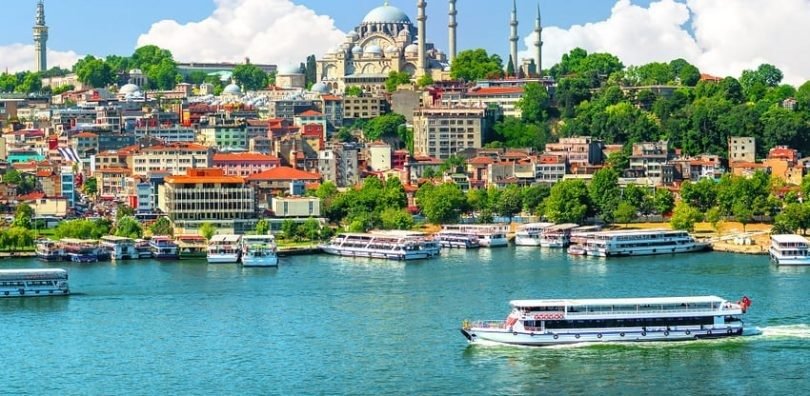

Article updated in January 2026 with 2026 public holidays and new Ramadan dates.
- 🌡️ Weather in Istanbul: Temperatures, Sun, and Rain
- 👥 When to avoid crowds and public holidays?
- 🎫 Book the Istanbul TouristPass
- 💰 Average hotel prices in Istanbul month by month
- 🗓️ Which season to choose?
- 🧑💻 My Personal Opinion: When to really go?
- 🌦️ What to do if the weather is capricious?
- 🌙 Visiting Istanbul during Ramadan (Dates 2026)
- 🧳 Checklist: What to pack?
- ❓ Frequently Asked Questions (FAQ)
- What budget to travel to Istanbul?
The best time to visit Istanbul is in spring (May-June) and autumn (September-October) to enjoy ideal temperatures around 20-25°C. For a budget-friendly trip, choose January and February, although the climate is cold and damp with temperatures dropping to 6°C.
🌡️ Weather in Istanbul: Temperatures, Sun, and Rain
Istanbul has a Mediterranean climate influenced by the Bosphorus, the Black Sea, and the Sea of Marmara. Istanbul is a windy and humid city where morning mists alternate with stormy showers.
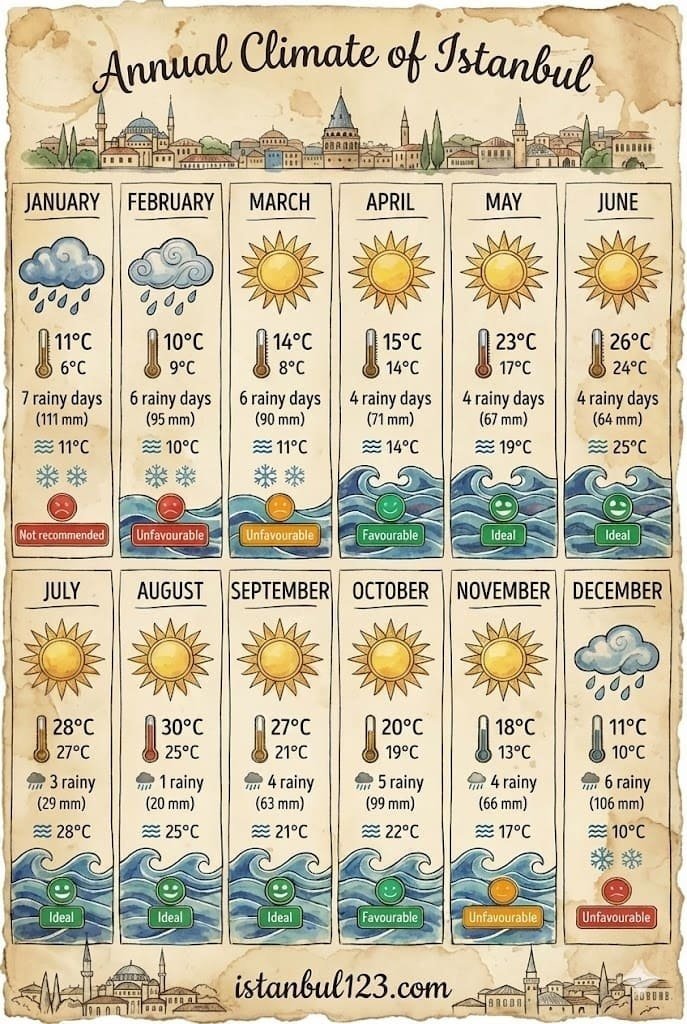
January is the coldest (6-11°C) and wettest month of the year, while July-August have the highest temperatures (25-28°C) with high humidity.
Light & Swimming by Season
| Season | Sunrise | Sunset | Sea Temp. | Golden Hour (Photo) |
|---|---|---|---|---|
| Winter | 08:15 | 17:45 | 8°C | 16:30 – 17:30 |
| Summer | 05:30 | 20:40 | 24°C | 19:30 – 20:30 |
👥 When to avoid crowds and public holidays?
Tourist crowds peak from June to August, when main sites like Hagia Sophia and Topkapi Palace are packed. Low season runs from November to March, offering a more authentic experience with fewer visitors.
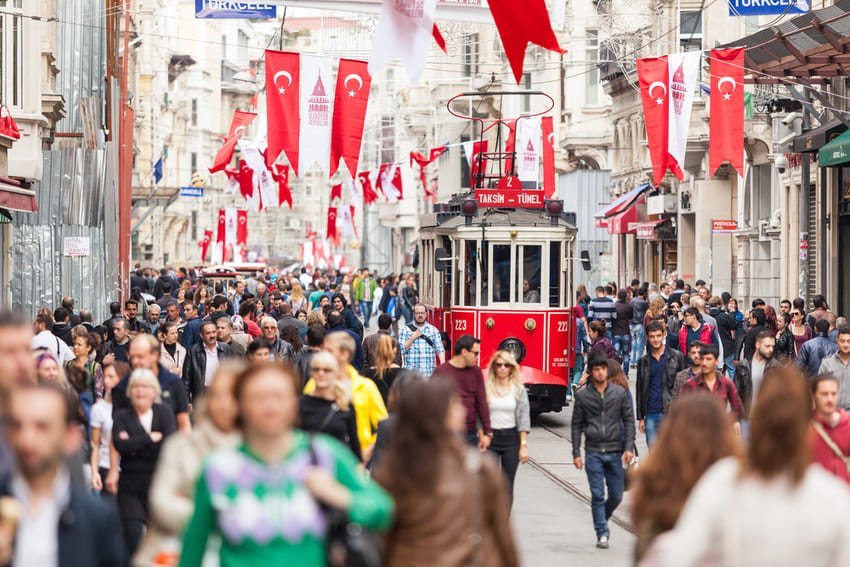
The best compromise between favorable weather and moderate crowds is April, May, September, and October.
🎫 Book the Istanbul TouristPass
💡 Kevin’s Tip: If you plan to visit several monuments, the Istanbul Tourist Pass® is clearly the deal you shouldn’t miss. With over 100 attractions included and skip-the-line tickets, you save time on every visit… and especially money. Concretely, from the third entry, the pass pays for itself: afterwards, it’s just a bonus for your holiday budget!
Public Holidays and Closures 2026
Watch out for these dates when banks close and transport is saturated:
- January 1st: New Year’s Day (Yılbaşı)
- March 20-22: Ramazan Bayramı (End of Ramadan Feast)
- April 23: National Sovereignty and Children’s Day
- May 1st: Labor Day (Avoid the Taksim area, demonstrations possible)
- July 15: Democracy and National Unity Day
- August 30: Victory Day (Zafer Bayramı)
- October 29: Republic Day (Fireworks on the Bosphorus, huge crowds)
💰 Average hotel prices in Istanbul month by month
Here is the chart showing the average prices for a night in a 3-star hotel in Istanbul throughout the year. With the lowest rates in January (£51) and the highest during the peak tourist season in August (£89).
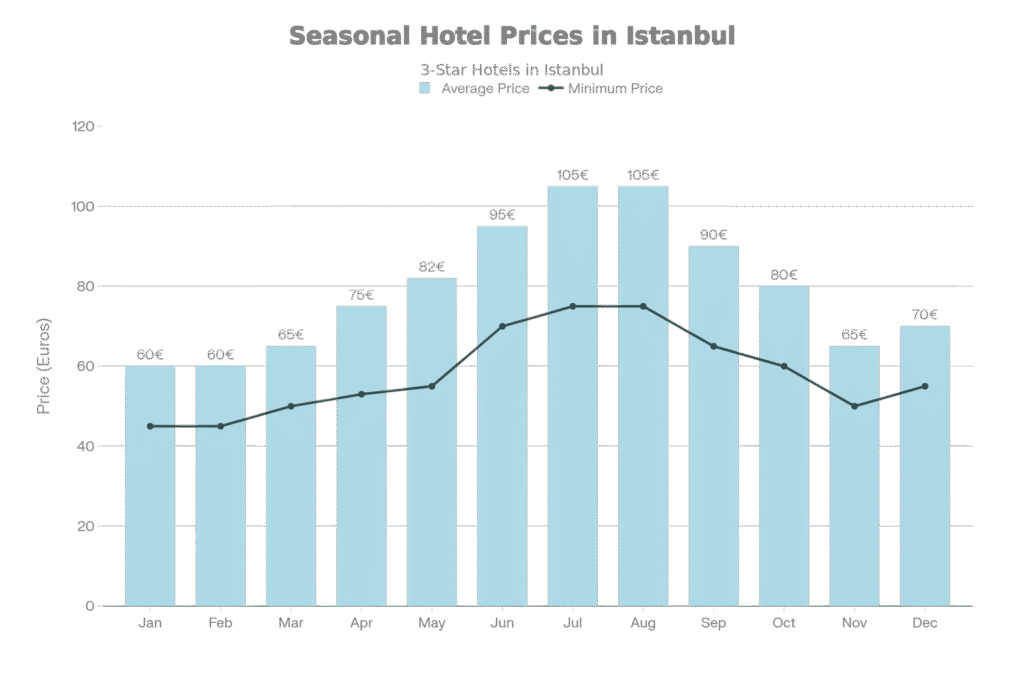
The blue bars represent the average monthly price, while the black line indicates the minimum price available for each month.
Budget Tip: Book your flight tickets at least 3 months in advance for the high season. In winter, luxury hotels (Pera Palace, Çırağan) often offer slashed rates with significant discounts.
🗓️ Which season to choose?
🌸 Spring (April – June): The City in Colors
Spring is one of the best seasons to discover Istanbul, with temperatures between 14-15°C in April and 24-26°C in June. The International Tulip Festival transforms the city in April with over 20 million tulips deployed in parks, particularly at Emirgan Park.
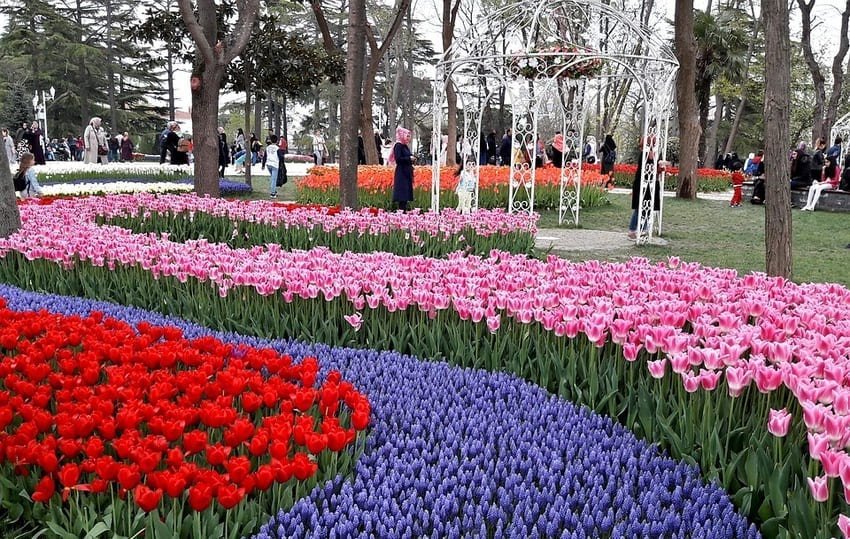
Recommended Itinerary (Good Weather): Morning at Emirgan Park to admire the tulips → Lunch in Ortaköy (Kumpir, stuffed potato) → Afternoon Bosphorus Cruise to enjoy the mild spring weather.
☀️ Summer (July – August): Heat and Sleepless Nights
Summer offers long, sunny days, ideal for exploring the city despite the heat and humidity. Temperatures hover between 25 and 30°C, with air sometimes stifling, tempered by the sea breeze. It’s the most touristy period with maximum crowds and high accommodation prices.

Recommended Itinerary (Heat): Early morning to visit Hagia Sophia before the crowds → Midday cool down in the underground Basilica Cistern → Afternoon swimming and relaxation at the Princes’ Islands.
🍂 Autumn (September – October): The Connoisseur’s Choice
September is considered the ideal period with pleasant temperatures (21-27°C) and less oppressive humidity than in summer. Most summer tourists have left, allowing you to enjoy the sites more quietly. In October, temperatures remain mild (19-20°C) with moderate rains starting to appear.
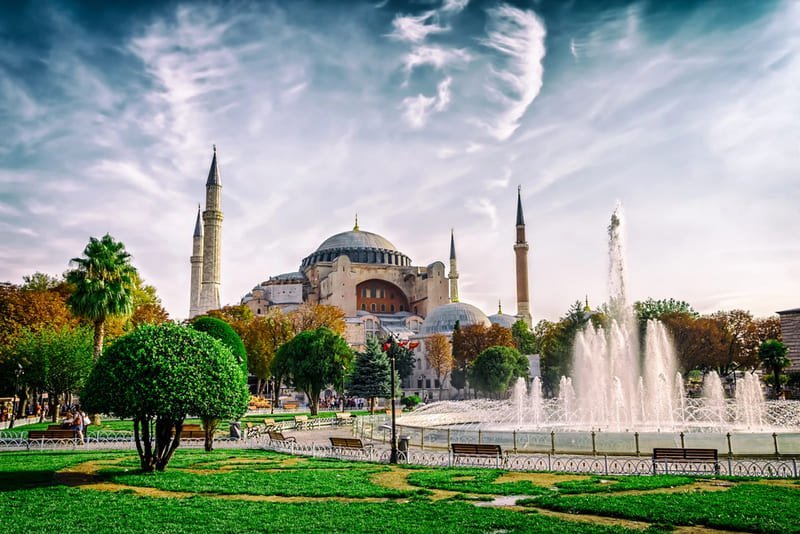
Gastronomy Plus: Autumn marks the return of abundant fishing in the Bosphorus, an excellent time to taste fresh fish in seaside restaurants under magnificent golden light.
❄️ Winter (November – March): Melancholy and Shopping
Winter in Istanbul is cold with temperatures potentially dropping below 5°C, sometimes offering magical snowy landscapes. February is the harshest month (9-10°C) with a risk of snow transforming the city into a postcard setting. It’s an authentic and economical period to discover Istanbul away from the crowds, despite the icy wind from the Bosphorus.
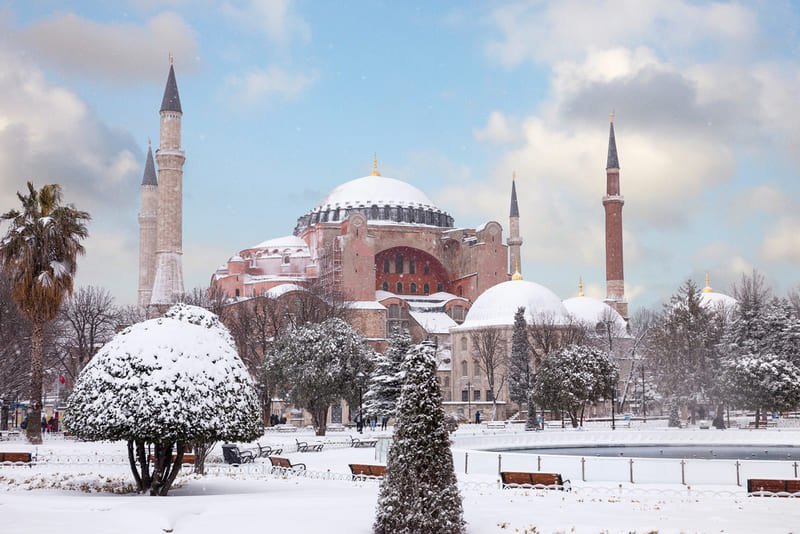
Recommended Itinerary (Grey/Rain): Morning at the fully covered Grand Bazaar → Afternoon at the Archaeological Museum followed by a hot tea or salep → Evening relaxation in a traditional Hammam.
🧑💻 My Personal Opinion: When to really go?
After visiting Istanbul in all seasons, here is my sincere recommendation for 2026.
If I had to choose just ONE ideal week, it would be the last week of May or the first of October. Why? Because it’s the absolute “sweet spot”: you avoid the stifling heat of July and the sometimes depressing greyness of February.
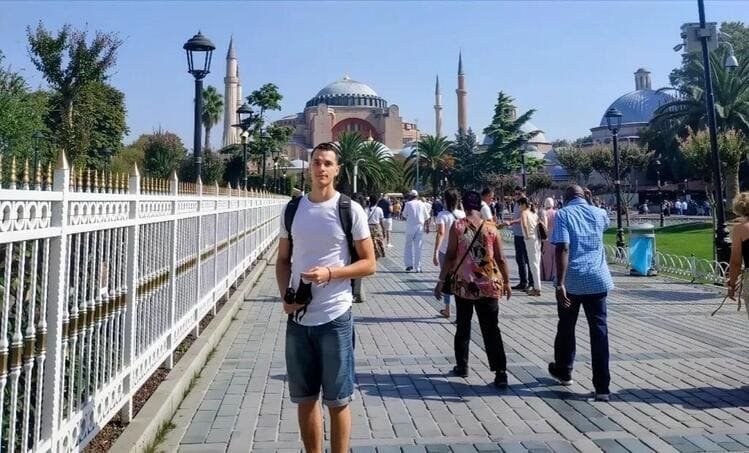
But be careful, don’t underestimate winter! I loved Istanbul in January for one simple reason: the city belongs to you. Being almost alone in the Basilica Cistern or negotiating quietly at the Grand Bazaar without being jostled is an incredible luxury that is well worth a few degrees less.
In summary: If you are looking for the perfect photo, aim for April (tulips) or September (light). If you are looking for authenticity and good deals, dare January.
🌦️ What to do if the weather is capricious?
If it’s pouring rain
- Visit underground places: the Basilica Cistern and the Theodosius Cistern offer a mysterious experience sheltered from the rain
- Explore major museums: Istanbul Modern, Pera Museum, and the underground shopping area of Galataport
- Browse the Grand Bazaar: this city within the city is fully covered and allows you to shop for hours
If it’s too hot (Heatwave)
- Take a ferry on the Bosphorus: the sea breeze naturally cools you down
- Take refuge in air-conditioned malls: Zorlu Center, Kanyon, or İstinye Park
- Visit mosques: their thick stone walls keep a natural coolness even in summer
🌙 Visiting Istanbul during Ramadan (Dates 2026)
Ramadan 2026 will begin around February 18 and end on March 19.
The dates you often see (March 19 to 21, 2026) correspond to Ramazan Bayramı (Eid al-Fitr), the 3 public holidays marking the end of fasting and the great celebration.

Contrary to popular belief, the city does not stop during the fasting month. On the contrary, Istanbul lives to the rhythm of two highlights: the relative calm of the day and the joyful effervescence as soon as the sun sets.
🧳 Checklist: What to pack?
- Winter: Windbreaker coat essential against the freezing Bosphorus wind, waterproof shoes to face rain and snow, scarf, and gloves.
- Summer: Light linen or breathable cotton clothes, hat and sunglasses, scarf for women (required to visit mosques).
- All year: Comfortable shoes absolutely necessary (heels are impossible on historic cobblestones), power adapter, and respectful attire for places of worship.
❓ Frequently Asked Questions (FAQ)
Does it rain a lot in Istanbul?
January is the wettest month (57mm), followed by December. Rains are frequent in winter but short and stormy in summer.
When is the best time to visit Istanbul?
May-June and September-October offer the best compromise between pleasant temperatures (20-25°C), low crowds, and moderate rates.
What is the hottest month in Istanbul?
July and August with temperatures regularly exceeding 30°C and high humidity.
Is it really cold in winter in Istanbul?
Yes, temperatures drop between 3°C and 10°C from December to February, with a freezing wind coming from the Bosphorus that accentuates the feeling.
Can you swim in Istanbul?
Yes, from June to September in the Princes’ Islands or on the Black Sea beaches. The sea temperature reaches 24°C in summer.
What is the cheapest month to go to Istanbul?
January and February are the most economical months: hotels starting from £111/night (vs £206 in July) and flights up to 40% cheaper.
How much does a 4-day trip to Istanbul cost?
Count £340-£510 per person in low season (flight + 3* hotel) and £680-£1020 in high season, excluding meals and activities.
When to book your flight to Istanbul for the best price?
At least 2-3 months in advance for the high season (summer). Low-cost airlines like Easyjet offer the best rates (£124 on average).
In summary: May and September are the royal times to visit Istanbul. January reigns supreme for savings. Regardless of the chosen date, Istanbul displays a unique atmosphere that transcends seasons.
What budget to travel to Istanbul?
How much does a holiday in Istanbul cost? Guide to prices & expenses to plan in Istanbul: Accommodation, Food, Transport, and Activities. Read our file to know what budget to plan for visiting Istanbul.
📢 Transparency Note from Kevin: This article contains affiliate links to a partner I personally use (GetYourGuide). For you, the price remains unchanged, but by using these links, you directly support my work and allow me to continue offering you these free Istanbul guides. Your visits fund my next simit with a good çay! Shukran! And go follow my Instagram page @kevinloveistanbul ❤️ Peace❤️

Leave a Comment